In our book Mathematical GeoEnergy, several geophysical processes are modeled — from conventional tides to ENSO. Each model fits the data applying a concise physics-derived algorithm — the key being the algorithm’s conciseness but not necessarily subjective intuitiveness.
I’ve followed Gell-Mann’s work on complexity over the years and so will try applying his qualitative effective complexity approach to characterize the simplicity of the geophysics models described in the book and on this blog.
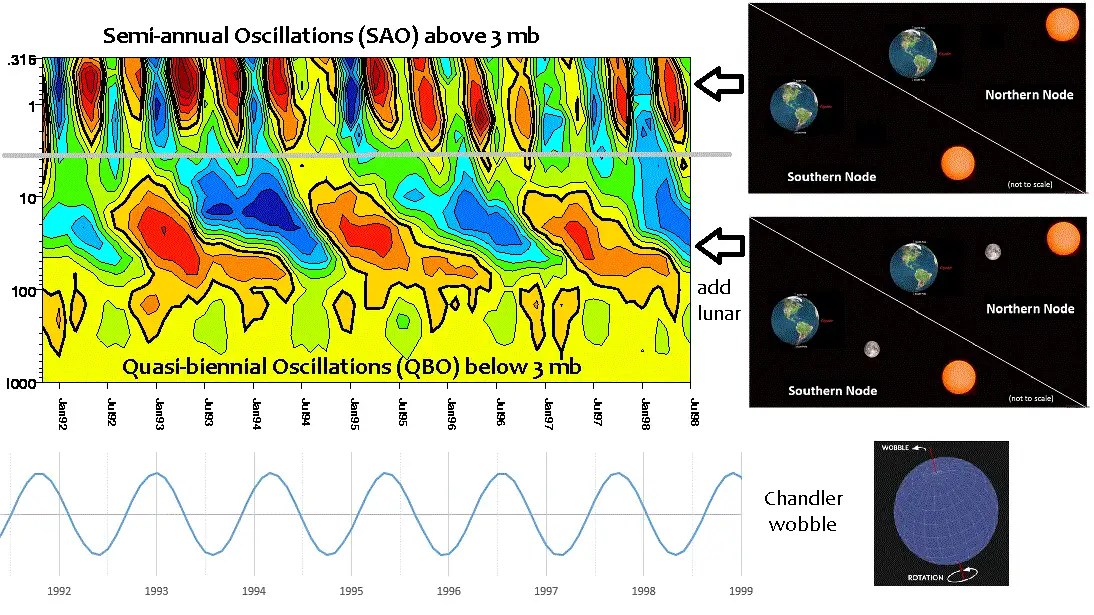
Chapter 11 of the book describes a model for the QBO of stratospheric equatorial winds. The stratified layers of the atmosphere reveal different dependencies on the external forcing depending on the altitude, see Fig 1.
Figure 1 : At high altitudes, only the sun’s annual cycle impacts the stratospheric as a semi-annual oscillation (SAO). Below that the addition of the lunar nodal cycle forces the QBO. The earth itself shows a clear wobble with the lunar cycle interacting with the annual.
Well above these layers are the mesosphere, thermosphere, and ionosphere. These are studied mainly in terms of space physics instead of climate but they do show tidal interactions with behaviors such as the equatorial electrojet [1].
The behaviors known as stratospheric sudden warmings (SSW) are perhaps a link between the lower atmospheric behaviors of equatorial QBO and/or polar vortex and the much higher atmospheric behavior comprising the electrojet. Papers such as [1,2] indicate that lunar tidal effects are showing up in the SSW and that is enhancing characteristics of the electrojet. See Fig 2.
Figure 2 : During SSW events, a strong modulation of period ~14.5 days emerges, close to the lunar fortnightly period as seen in these spectrograms. Taken from ref [2] and see quote below for more info.
“Wavelet spectra of foEs during two SSW events exhibit noticeable enhanced 14.5‐day modulation, which resembles the lunar semimonthly period. In addition, simultaneous wind measurements by meteor radar also show enhancement of 14.5‐day periodic oscillation after SSW onset.”
Tang et al [2]
So the SSW plays an important role in ionospheric variations, and the lunar tidal effects emerge as the higher atmospheric density of a SSW upwelling becomes more sensitive to lunar tidal forcing. That may be related to how the QBO also shows a dependence on lunar tidal forcing due to its higher density.
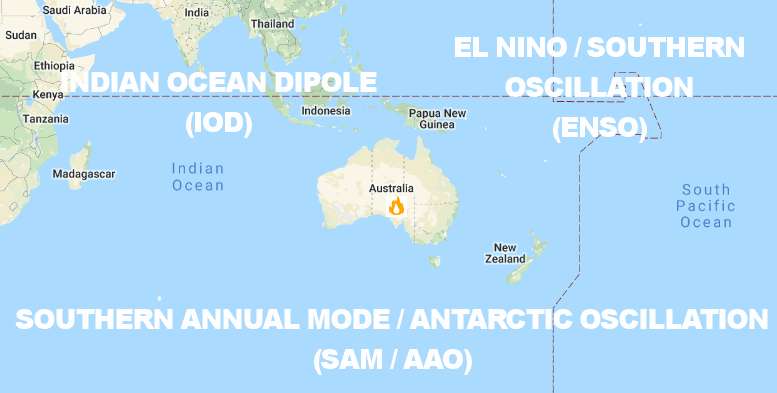
In Chapter 12 of the book, we focused on modeling the standing-wave behavior of the Pacific ocean dipole referred to as ENSO (El Nino /Southern Oscillation). Because it has been in climate news recently, it makes sense to give equal time to the Atlantic ocean equivalent to ENSO referred to as the Atlantic Multidecadal Oscillation (AMO). The original rationale for modeling AMO was to determine if it would help cross-validate the LTE theory for equatorial climate dipoles such as ENSO; this was reported at the 2018 Fall Meeting of the AGU (poster). The approach was similar to that applied for other dipoles such as the IOD (which is also in the news recently with respect to Australia bush fires and in how multiple dipoles can amplify climate extremes [1]) — and so if we can apply an identical forcing for AMO as for ENSO then we can further cross-validate the LTE model. So by reusing that same forcing for an independent climate index such as AMO, we essentially remove a large number of degrees of freedom from the model and thus defend against claims of over-fitting.
In Chapter 13 of the book, we have a description of the mechanism forcing the Chandler Wobble in the Earth’s rotation. As a counter to a recent GeoenergyMath post suggesting there is little consensus behind this mechanism, a recent paper by Na et al provides a foundation to understand how the lunar forcing works.
Chandler wobble and free core nutation are two major modes of perturbation in the Earth rotation. Earth rotation status needs to be known for the coordinate conversion between celestial reference frame and terrestrial reference frame. Due mainly to the tidal torque exerted by the moon and the sun on the Earth’s equatorial bulge, the Earth undergoes precession and nutation.
In Chapter 18 of the book, we discuss the behavior around critical points in the context of reliability, both at the small-scale in terms of component breakdown, and in the large-scale in the context of earthquake triggering which was introduced in Chapter 13. The connection is that things break at all scales, with the common mechanism of a varying rate of progression to the critical point:
As indicated in the figure caption, the failure rate is generally probabilistic but with known external forcings, there is the potential for a better deterministic prediction of the breakdown point, which is reviewed below:
In Chapter 12 of the book, we describe in detail the solution to Laplace’s Tidal Equations (LTE), which were introduced in Chapter 11. Like the solution to the linear wave equation, where there are even (cosine) and odd (sine) natural responses, there are also even and odd responses for nonlinear wave equations such as the Mathieu equation, where the natural response solutions are identified as MathieuC and MathieuS. So we find that in general the mix of even and odd solutions for any modeled problem is governed by the initial conditions of the behavior along with any continuing forcing. We will describe how that applies to the LTE system next:
In Chapter 13 of the book, we have a description of the mechanism forcing the Chandler Wobble in the Earth’s rotation. Even though there is not yet a research consensus on the mechanism, the prescribed lunisolar forcing seemed plausible enough that we included a detailed analysis in the text. Recently we have found a recent reference to a supporting argument to our conjecture, which is presented below …
Continuing with Chapter 13 of the book, we also analyze the factors that perturb the Earth’s rotation rate and therefore the observed length-of-day (LOD). Researchers continue to update the characterization of the LOD, such as here, which we can compare against a straightforward model based on the accepted lunisolar gravitational forcing factors …
In Chapter 13 of the book, we have a description of the mechanism causing the Chandler wobble of the Earth’s polar axis. Last fall, NASA updated a description of their understanding of the axis drift [1] described here, which we can place in context with the model …