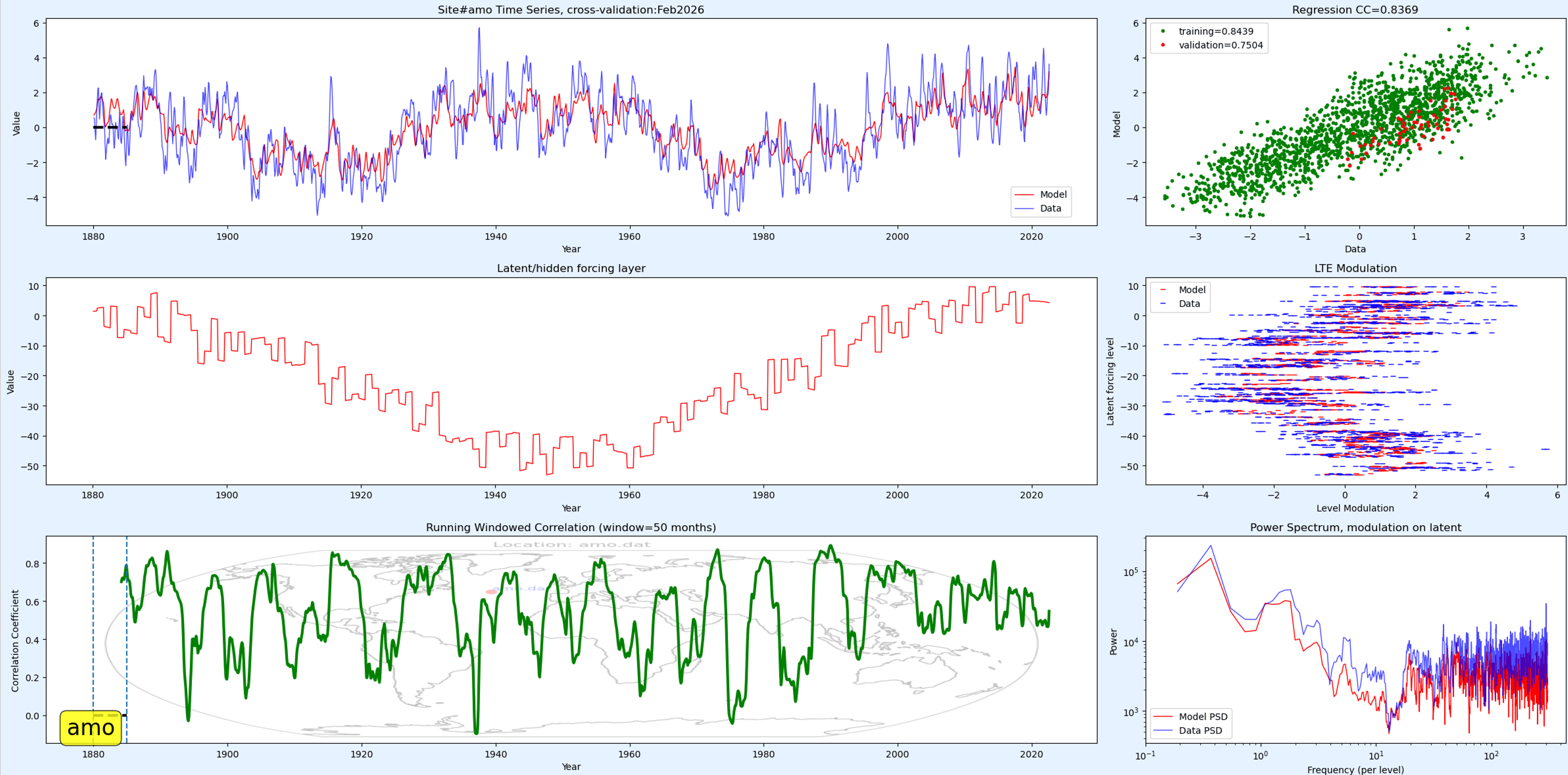
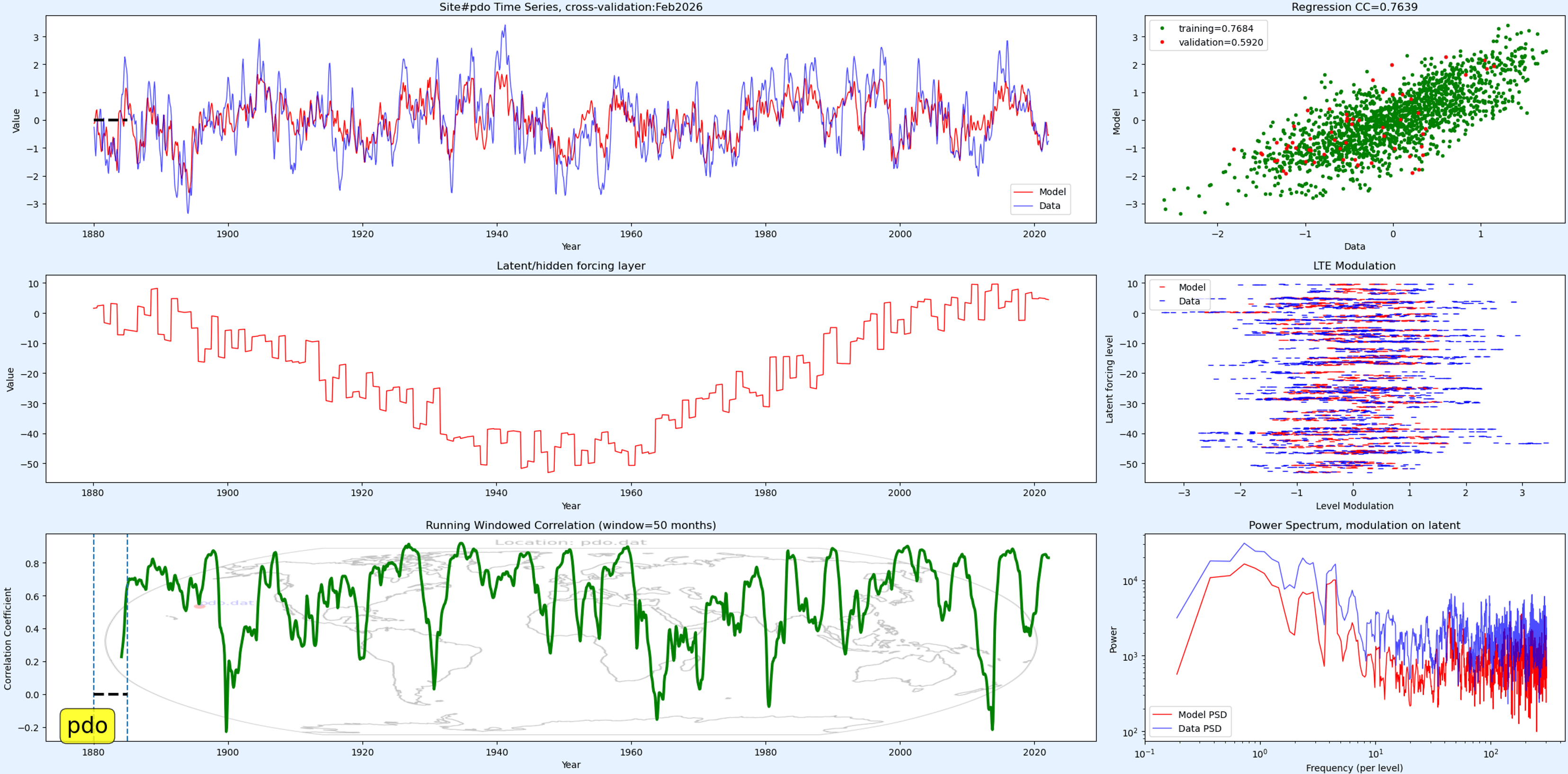
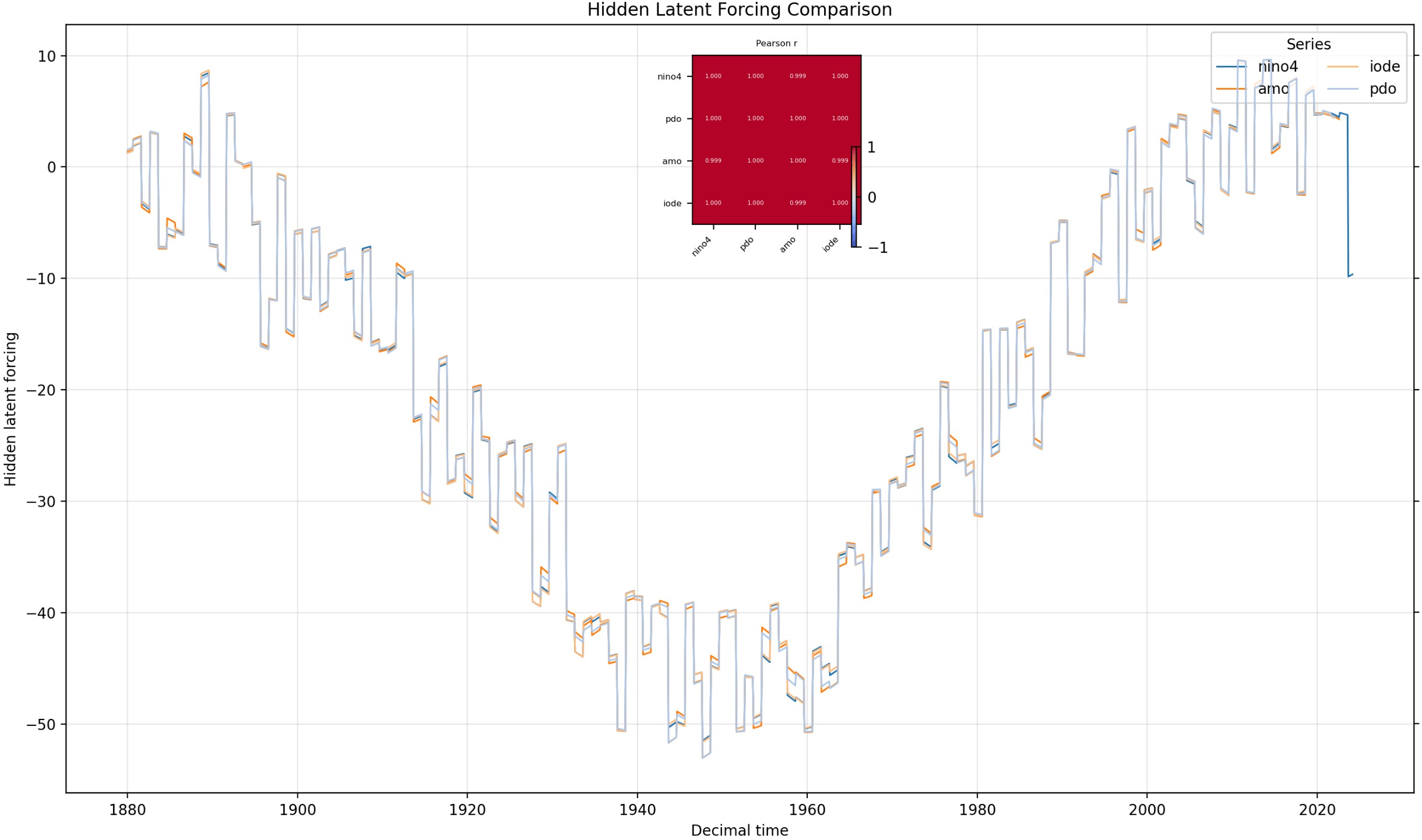
An algorithm that simultaneously optimizes the model fit to two disparate climate indices while keeping the hidden latent manifold constant. The two indices chosen, AMO and PDO, occur in separated ocean basins and show longer term variations, so that a multi-scale fit is necessary. The hidden latent manifold uses as a starting point the calibrated tidal factors needed to match the Earth’s LOD variations — the same torques that presumably cause the ocean’s thermocline to slosh. Only a slight perturbation to the tidal factors — amounting to a 0.996 correlation coefficient (instead of 1.0) to the calibrated LOD was needed to tweak the manifold during the fitting process.
AMO
PDO
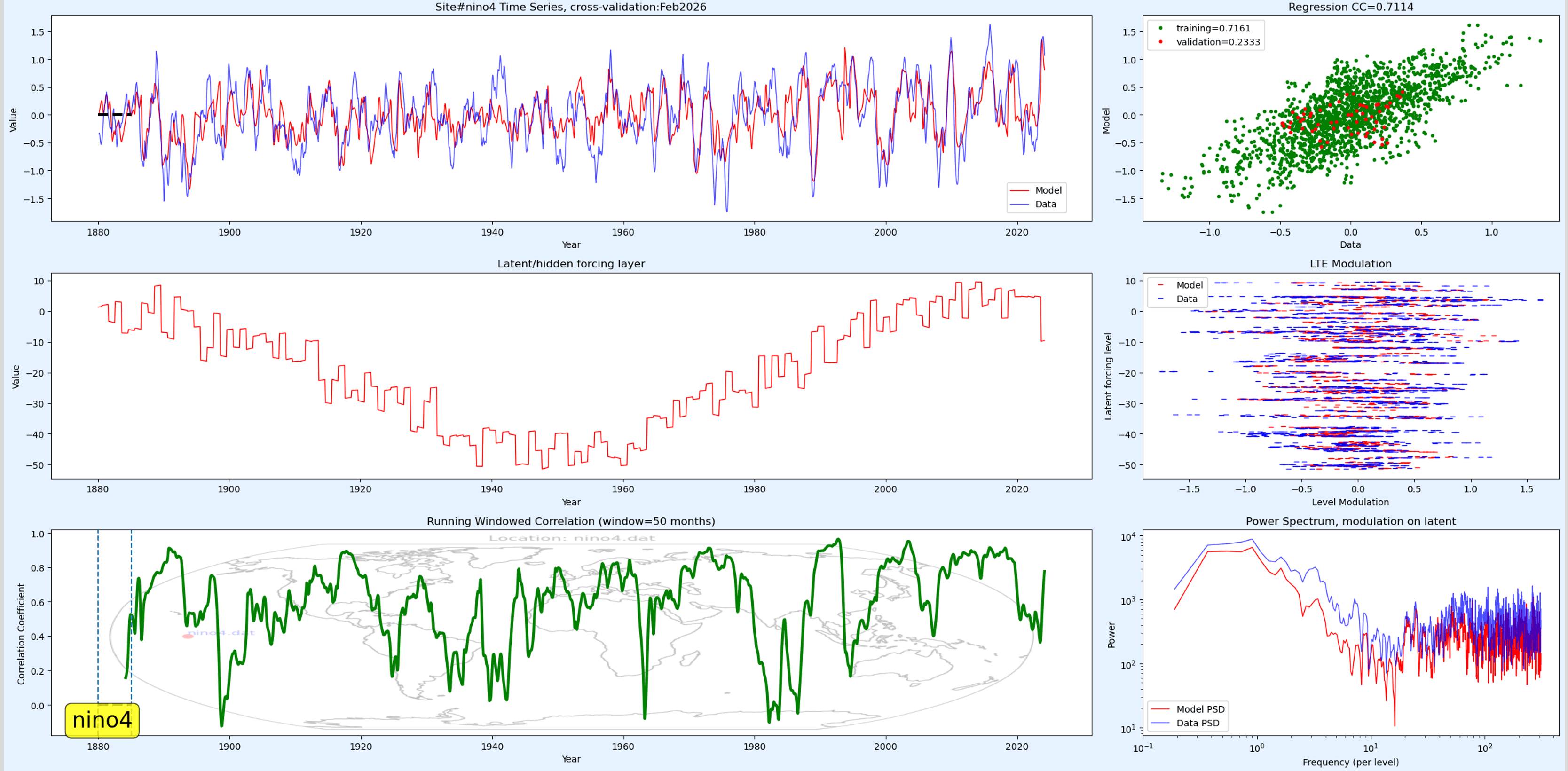
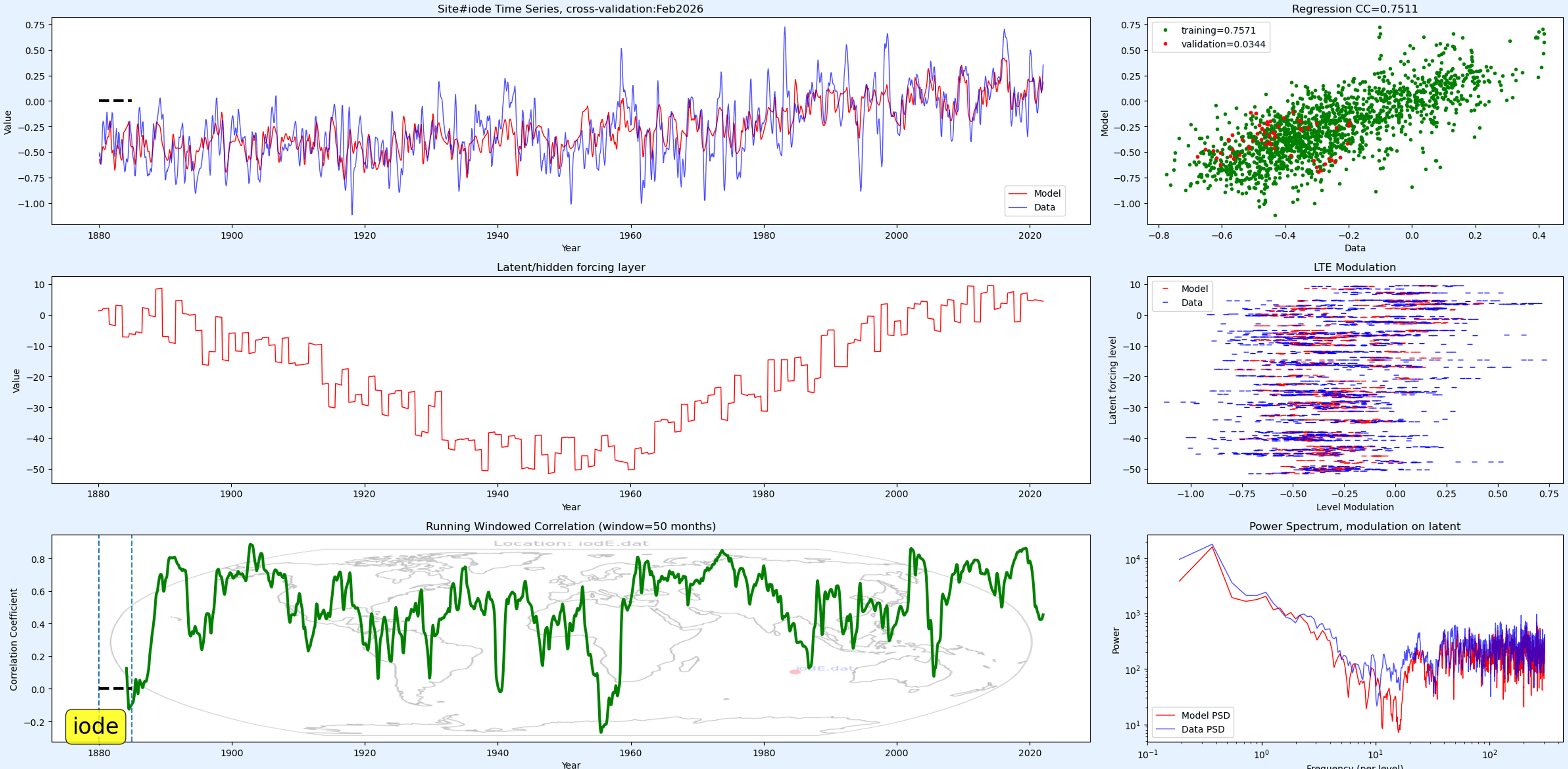
Can then use PDO as a seed to model NINO4 and IOD-East
NINO4
IOD-East
The manifolds are all aligned (below) with slight jogs that were caused by letting the fitting routine to proceed beyond the locked manifold stage.
Have not included NAO in this set of comparisons yet since NAO has an interesting relationship to AMO. If the value of AMO from 12 months back is fed back into the current AMO with a negative sign (a delay differential), and then the correlation coefficient is computed, that value is significant, especially on more recent values.
The plot below is an expedited fit that does a delay differential on the AMO model to emulate the NAO time series. Note that the fit degrades in the years 1890-1900 and 1915-1920, the same years that the above pot shows anti-correlations.
NAO
Also averaged Baltic MSL time-series. Has a dominant LTE mode, higher in winding frequency than the other indices.
Baltic MSL
It is so strong that other LTE windings do not contribute much to the variation in extremes.
Someone on Twitter suggested that tidal models are not understood “The tides connection to the moon should be revised.”. Unrolled thread after the “Read more” break
The machine learning community needs to be let loose on this data. The tidal forcing is a latent or hidden layer that ML models such a SINDy, KAN, and others could easily handle. I don't use ML other than to fit the models with known tidal factors – ManMachineLearning so far.
A climate teleconnection is understood as one behavior impacting another — for example NINOx => AMO, meaning the Pacific ocean ENSO impacting the Atlantic ocean AMO via a remote (i.e. tele) connectiion. On the other hand, a common-mode behavior is a result of a shared underlying cause impacting a response in a uniquely parameterized fashion — for example NINOx = g(F(t), {n1, n2, n3, ...}) and AMO = g(F(t), {a1, a2, a3, ...}), where the n's are a set of constant parameters for NINOx and the a's are for AMO.
In this formulation F(t) is a forcing and g() is a transformation. Perhaps the best example of a common-mode response to a forcing is in the regional tidal response in local sea-level height (SLH). Obviously, the lunisolar forcing is a common mode in different regions and subtle variations in the parametric responses is required to model SLH uniquely. Once the parameters are known, one can make practical predictions (subject to recalibration as necessary).
By applying an annual impulse sample-and-hold on a common-mode basis set of tidal factors, a wide range of climate indices can be modeled and cross-validated. Whether it is a biennial impulse or annual impulse, the slowly modulating envelope is roughly the same, thus models of multidecadal indices such as AMO and PDO show similar skill — with cross validation results evaluated here for a biennial impulse. Now we will evaluate for annual impulse.
The truly massive scale in the motion of fluids and solids on Earth arises from orbital interactions with our spinning planet. The most obvious of these, such as the daily and seasonal cycles, are taken for granted. Others, such as ocean tides, have more complicated mechanisms than the ordinary person realizes (e.g. ask someone to explain why there are 2 tidal cycles per day). There are also less well-known motions, such as the variation in the Earth’s rotation rate of nominally 360° per day, which is called the delta in Length of Day (LOD), and in the slight annual wobble in the Earth’s rotation axis. Nevertheless, each one of these is technically well-characterized and models of the motion include a quantitative mapping to the orbital cycles of the Sun, Moon, and Earth. This is represented in the directed graph below, where the BLUE ovals indicate behaviors that are fundamentally understood and modeled via tables of orbital factors.
The cyan background represents behaviors that have a longitudinal dependence (rendered by GraphViz)
However, those ovals highlighted in GRAY are nowhere near being well-understood in spite of being at least empirically well-characterized via years of measurements. Further, what is (IMO) astonishing is the lack of research interest in modeling these massive behaviors as a result of the same orbital mechanisms as that which causes tides, seasons, and the variations in LOD. In fact, everything tagged in the chart is essentially a behavior relating to an inertial response to something. That something, as reported in the Earth sciences literature, is only vaguely described — and never as a tidal or tidal/annual interaction.
I don’t see how it’s possible to overlook such an obvious causal connection. Why would the forcing that causes a massive behavior such as tides suddenly stop having a connection to other related inertial behaviors? The answers I find in the research literature are essentially that “someone looked in the past and found no correlation”[1].
In Mathematical Geoenergy, Chapter 12, a biennially-impulsed lunar forcing is suggested as a mechanism to drive ENSO. The current thinking is that this lunar forcing should be common across all the oceanic indices, including AMO for the Atlantic, IOD for the Indian, and PDO for the non-equatorial north Pacific. The global temperature extreme of the last year had too many simultaneous concurrences among the indices for this not to be taken seriously.
NINO34
PDO
AMO
IOD – East
IOD-West
Each one of these uses a nearly identical annual-impulsed tidal forcing (shown as the middle green panel in each), with a 5-year window providing a cross-validation interval. So many possibilities are available with cross-validation since the tidal factors are essentially invariantly fixed over all the climate indices.
The approach follows 3 steps as shown below
The first step is to generate the long-period tidal forcing. I go into an explanation of the tidal factors selected in a Real Climate comment here.
Then apply the lagged response of an annual impulse, in this case alternating in sign every other year, which generates the middle panel in the flow chart schematic (and the middle panel in the indexed models above).
Finally, the Laplace’s Tidal Equation (LTE) modulation is applied, with the lower right corner inset showing the variation among indices. This is where the variability occurs — the best approach is to pick a slow fundamental modulation and generate only integer harmonics of this fundamental. So, what happens is that different harmonics are emphasized depending on the oceanic index chosen, corresponding to the waveguide structure of the ocean basin and what standing waves are maximally resonant or amplified.
Note that for a dipole behavior such as ENSO, the LTE modulation will be mirror-inverses for the maximally extreme locations, in this case Darwin and Tahiti
A machine learning application is free to scrape the following GIST GitHub site for model fitting artifacts.
Another analysis that involved a recursively cycled fit between AMO and PDO. It switched fitting AMO for 2.5 minutes and then PDO for 2.5 minutes, cycling 50 times. This created a common forcing with an optimally shared fit, forcing baselined to PDO.
PDO
AMO
NINO34
IOD-East
IOD-West
Darwin
Tahiti
The table above shows the LTE modulation factors for Darwin and Tahiti model fits. The highlighted blocks show the phase of the modulation, which should have a difference of π radians for a perfect dipole and higher harmonics associated with it. (The K0 wavenumber = 0 has no phase, but just a sign). Of the modes that are shared 1, 45, 23, 36, 18, 39, 44, the average phase is 3.09, close to π (and K0 switches sign).
Contrast to the IOD East/West dipole. Only the K0 (wavenumber=0) shows a reversal in sign. The LTE modulation terms are within 1 radian of each other, indicating much less of a dipole behavior on those terms. It’s possible that these sites don’t span a true dipole, either by its nature or from siting of the measurements.
Cross-validating a large interval span on PDO
using CC
using DTW metric, which pulls out more of the annual/semi-annual signal
adding a 3rd harmonic
Complement of the fitting interval, note the spectral composition maintains the same harmonics, indicating that the structure mapped to is stationary in the sense that the tidal pattern is not changing and the LTE modulation is largely fixed.
This is the resolved tidal forcing, finer than the annual impulse sampling used on the models above.
Below can see the primary 27.5545 lunar anomalistic cycle, mixed with the draconic 27.2122/13.606 cycle to create the 6/3 year modulation and the 206 day perigee-syzygy cycle (or 412 full cycle, as 206 includes antipodal full moon or new moon orientation).
The ocean is stunning at the moment. Many hotspots. This viz puts the recent global SST anomalies into the context of the last 4 decades. Look closely. Some regions are "on trend," some are short-term spikes, and some are combinations.#GlobalWarming#ClimateEmergencypic.twitter.com/0xf188RPgJ
These correspond to the geographically defined climate indices
Overall I’m confident with the status of the published analysis of Laplace’s Tidal Equations in Mathematical Geoenergy, as I can model each of these climate indices with precisely the same (save one ***) tidal forcing, all calibrated by LOD. The following Threads allow interested people to contribute thoughts
The only hope for a non-controlled-experiment-verified model to gain acceptance is either by (1) showing repeated success in predictions, or, precluding that due to long cycle time (2) producing rock-solid cross-validation results. Why? Let ChatGPT-4 answer:
The Gist site on GitHub allows you to comment on posts very easily. For example, images of charts can be pasted in the discussion area. Also snippets of code can be added and updated, which is useful for neural net evaluation. The following is a link to an initial Gist area for evaluating LTE models.
Comparison of LTE models applying slight variations of tidal forcing but larger allowance of basin tidal modulation
NdGT has a point — you do see the earth’s shadow moving across the moon, but once covered, a #lunarEclipse just looks like a duller moon (similar “new moons” are also observed like clockwork and thus take the excitement out of it). Yet the alignment of tidal forces does a number on the Earth’s climate that is totally cryptic and thus overlooked. Perhaps old Dr. Neil would find more interesting tying lunar cycles to climate indices such as ENSO and the Indian Ocean Dipole? It’s all based on geophysical fluid dynamics. Oh, and a bonus — discriminate on the variability of IOD and there’s the underlying AGW trend!
BTW, a key to this IOD model fit is to apply dual annual impulses, one for each monsoon season, summer and winter. Whereas, ENSO only has the spring predictability barrier.