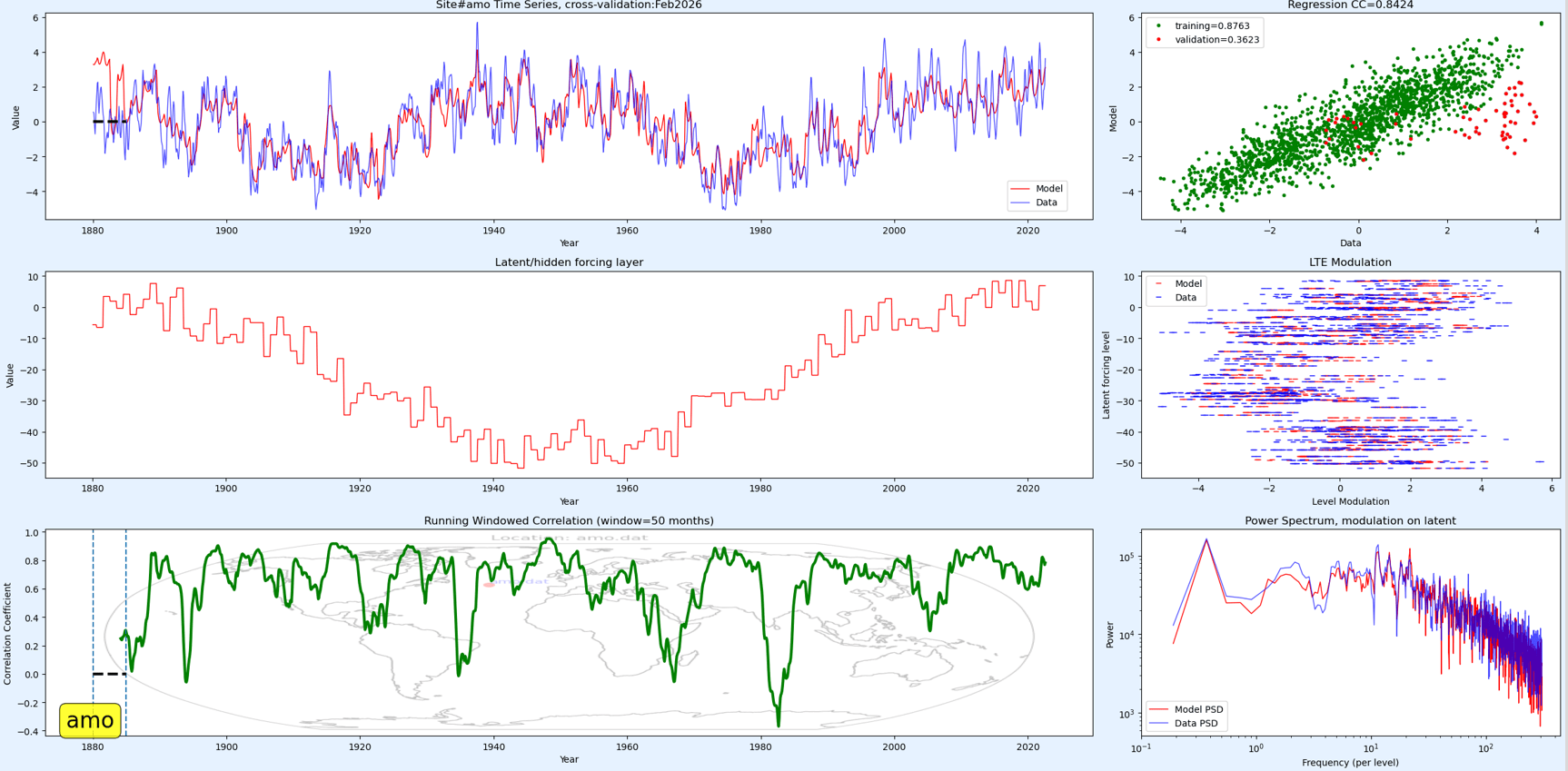
With the interest in the El Nino brewing, don’t neglect the AMO in the Atlantic. In my research, I apply tidal forcing as a driver for modeling climate indices, and have long noticed that a balanced ~120-year cycle emerges via interactions with the annual cycle. This produces large excursions both + and -, which is interesting because it was legendary oceanographer Walter Munk who proposed that large forcing of subsurface fluid volume produces frictional loss independent of the sign of a fluid’s velocity. The implication is that the ~120-year tidal cycle is rectified to produce a ~60-year cycle, which hints at the AMO 50-70 year cycle. Moreover, the model of the tidal cycle produces a ragged stepped staircase over that long period, of which the individual steps also map to the fast cycles of AMO (easily seen in NAO as well).
I have an extended optimizing simulator for this project, but I factored out the essential features for a one-pass model fit to the AMO data here: https://gist.github.com/pukpr/05687a46cf1a5b76b2ba6ae589343172
The rectification is clearly seen in the middle-right panel below (a so-called latent hidden manifold), and all the ragged steps (in the middle left panel) map non-linearly to the AMO fast cycles in the top panel.
Munk & Wunsch (2002) – “Millennial Climate Variability: Is There a Tidal Connection?”
https://journals.ametsoc.org/view/journals/clim/15/4/1520-0442_2002_015_0370_mcvita_2.0.co_2.pdf
LOD paper, a reminder that the variations in AMO are opposite in sign to the long-term LOD variations
https://cyberleninka.ru/article/n/consistency-of-intra-centennial-oscillations-in-length-of-day-and-oceanic-characteristics/viewer
Going pack in time for AMO
“Imprint of the Atlantic Multidecadal Oscillation on Tree-Ring Widths in Northeastern Asia since 1568”
https://journals.plos.org/plosone/article/figure/image?size=inline&id=10.1371/journal.pone.0022740.g003