This is a continuation from the previous Length of Day post showing how closely the ENSO forcing aligns to the dLOD forcing.
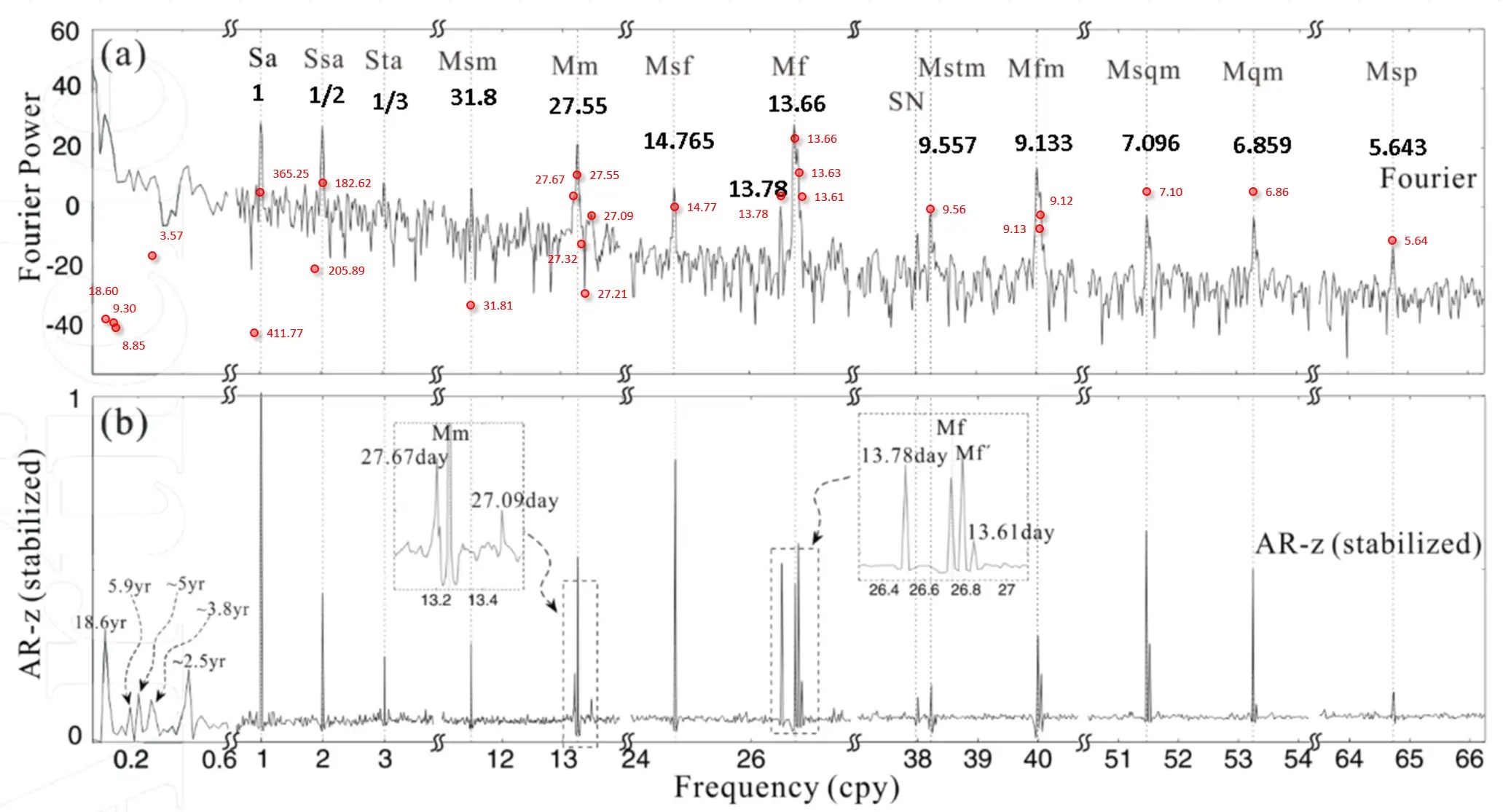
Ding & Chao apply an AR-z technique as a supplement to Fourier and Max Entropy spectral techniques to isolate the tidal factors in dLOD
- H. Ding and B. F. Chao, “Application of stabilized AR‐z spectrum in harmonic analysis for geophysics,” Journal of Geophysical Research: Solid Earth, vol. 123, no. 9, pp. 8249–8259, 2018.
The red data points are the spectral values used in the ENSO model fit.
The top panel below is the LTE modulated tidal forcing fitted against the ENSO time series. The lower panel below is the tidal forcing model over a short interval overlaid on the dLOD/dt data.

That’s all there is to it — it’s all geophysical fluid dynamics. Essentially the same tidal forcing impacts both the rotating solid earth and the equatorial ocean, but the ocean shows a lagged nonlinear response as described in Chapter 12 of the book. In contrast, the solid earth shows an apparently direct linear inertial response. Bottom line is that if one doesn’t know how to do the proper GFD, one will never be able to fit ENSO to a known forcing.