Gavin Schmidt of NASA tweeted a cite to a recent paper on QBO by a group of 12 scientists
Geller, M. A., Zhou, T., Shindell, D., Ruedy, R., Aleinov, I., Nazarenko, L., Tausnev, N.L., Kelley, M., Sun, S., Cheng, Y., Field, R.D. and Faluvegi, G. (2016), Modeling the QBO – Improvements Resulting from Higher Model Vertical Resolution. J. Adv. Model. Earth Syst.. doi:10.1002/2016MS000699
They claim that the fundamental frequency of QBO relates inversely proportional to the pressure:
“The mean zonal winds from the ERA-Interim reanalysis are shown between 4.5 and 4.5 N between heights of 100 and 1 hPa for the 20 years 1991-2010. Note that ERA-Interim shows that approximately 8 1/2 QBO cycles occurred during this period, implying a QBO period averaging about 28 months. The model results in figure 1b show that no coherent QBO resembling observations exists for the gravity wave momentum flux forcing of 1.5 mPa, which is consistent with the steady jets at low wave forcing demonstrated by Yoden and Holton (1988). It also shows that the QBO-like oscillation for a gravity wave momentum flux forcing of 2.0 mPa has a period of about 8 years, while a forcing of 2.5 mPa gives a period of about 37 months, and a forcing of 3.0 mPa gives a period of about 25 months, and a forcing of 3.5 mPa gives a period of about 21 months. In fact, we find that the best fit to observed QBO periods is for a gravity wave momentum flux forcing of 2.9 mPa, as will be shown in the next section. “
I disagree with this interpretation. I know that this might sound like I am using the argument of personal astonishment, but I can’t see how a physical model could operate this way. If anything, pressure may modify the amplitude of the oscillations, i.e. the peak speed, but asserting that the pressure sets the oscillation period is likely the result of a model that no one understands. If it was indeed caused by the pressure, they should be able to come up with a simplified formula, like deriving the resonant frequency of a Rijke tube, instead of suggesting that it is an emergent property of a complicated model. Certainly, pitch can change as a result of say overblowing a woodwind instrument, but even there, the shifts are more than likely harmonics or overtones of the original fundamental frequency, and not a continuous change in frequency.

RHEED oscillations more here
And I realize that the QBO is obviously not an acoustic oscillation yet the physical model for any oscillation does need some sort of mathematically intuitive explanation (see figure to the right), which is greatly lacking in this paper. To say it emerges from the model is an extremely weak argument.
The 28 month period is ubiquitous in a number of geophysical oscillations. It shows up in (1) the seasonally aliased Draconic lunar cycle, (2) the strongest factor in the model of ENSO, (3) exactly half that period in the Chandler Wobble, (4) its defined as the mean annual flood recurrence interval by the USGS (first reported in 1960), and (5) the fundamental QBO period.
Perhaps no one wants to admit that seeing this number show up in all these measures is most likely a forced response from the nodal lunar cycle factor, as opposed to a natural resonance. The reality is that a forced response is not as “sexy” as finding a natural frequency eigenvalue.
But of course there is no way to verify either way, since a controlled experiment is not available to test a model against. There is only one earth and it can’t be duplicated in the lab. All we have to go on is the empirical data and any model that we can dream up.
A bunch of meteorologists are freaking out that the current QBO data is not meeting up to expectations
Great graphical illustration of the bizarre QBO behaviour seen this year. It just shouldn’t happen and yet it has. https://t.co/2EsWpDGuow
— Ed O’Toole (@chionomaniac) June 18, 2016
//platform.twitter.com/widgets.js
All QBO layers between 50mb-10mb peaked at the same time in September 2015. That should not happen, but it did. pic.twitter.com/7V3sY4jYp4
— Anthony Masiello (@antmasiello) June 17, 2016
//platform.twitter.com/widgets.js
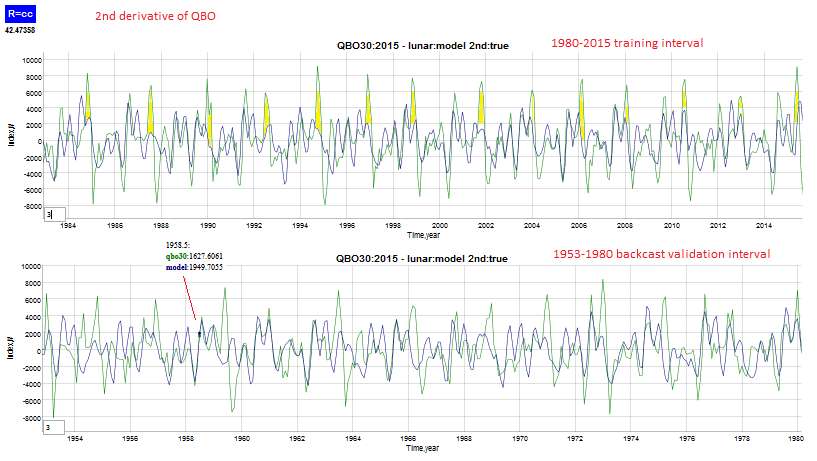
I don’t understand the rarity of this since the higher altitude QBO aligns more with semiannual seasonal cycles, while the lower altitude QBO aligns more with the nodal lunar cycles. These will constructively add according to a beat frequency and so the alignment will occur occasionally. This summer solstice there is a full moon and that only happens once every 19 years. I can see this with my QBO model as well, so what is the big deal?


![F(Theta) = frac{1}{sigma^2} left( frac{d^2Theta}{dmu^2} - left[frac{s}{sigma} + s^2right] Theta right)](https://s0.wp.com/latex.php?latex=F%28Theta%29+%3D+frac%7B1%7D%7Bsigma%5E2%7D+left%28+frac%7Bd%5E2Theta%7D%7Bdmu%5E2%7D+-+left%5Bfrac%7Bs%7D%7Bsigma%7D+%2B+s%5E2right%5D+Theta+right%29&bg=ffffff&fg=444444&s=0&c=20201002)

![F(Theta) = - frac{1}{sigma^2} left( frac{d^2Theta}{d t^2} frac{1}{mu_0 omega^2 sin(omega t)} + left[frac{s}{sigma} + s^2right] Theta right)](https://s0.wp.com/latex.php?latex=F%28Theta%29+%3D+-+frac%7B1%7D%7Bsigma%5E2%7D+left%28+frac%7Bd%5E2Theta%7D%7Bd+t%5E2%7D+frac%7B1%7D%7Bmu_0+omega%5E2+sin%28omega+t%29%7D+%2B+left%5Bfrac%7Bs%7D%7Bsigma%7D+%2B+s%5E2right%5D+Theta+right%29&bg=ffffff&fg=444444&s=0&c=20201002)
![frac{1}{sigma^2} left( frac{d^2Theta}{d t^2} frac{1}{mu_0 omega^2 sin(omega t)} + left[frac{s}{sigma} + s^2right] Theta right) + gamma Theta = f(t)](https://s0.wp.com/latex.php?latex=frac%7B1%7D%7Bsigma%5E2%7D+left%28+frac%7Bd%5E2Theta%7D%7Bd+t%5E2%7D+frac%7B1%7D%7Bmu_0+omega%5E2+sin%28omega+t%29%7D+%2B+left%5Bfrac%7Bs%7D%7Bsigma%7D+%2B+s%5E2right%5D+Theta+right%29+%2B+gamma+Theta+%3D+f%28t%29&bg=ffffff&fg=444444&s=0&c=20201002)
![frac{d^2Theta}{dt^2} + left[frac{s}{sigma} + s^2 + sigma^2 gamma right] Theta mu_0 omega^2 sin(omega t) = sigma^2 mu_0 omega^2 sin(omega t) f(t)](https://s0.wp.com/latex.php?latex=frac%7Bd%5E2Theta%7D%7Bdt%5E2%7D+%2B+left%5Bfrac%7Bs%7D%7Bsigma%7D+%2B+s%5E2+%2B+sigma%5E2+gamma+right%5D+Theta+mu_0+omega%5E2+sin%28omega+t%29+%3D+sigma%5E2+mu_0+omega%5E2+sin%28omega+t%29+f%28t%29&bg=ffffff&fg=444444&s=0&c=20201002)