These are a set of 6 EOFs that describe the global SST in terms of a set of orthogonal time-series — essentially non-overlapping, each having a cross-correlation of ~0.0 with the others, like a sine/cosine pair, but in both spatial and temporal dimensions.
The cross-validation described earlier was rather limited. Here an attempt is made to fit to an interval of the Darwin time-series and see how well it matches to a longer out-of-band validation interval. Very few degrees of freedom are involved in this procedure as the selection of tidal factors is constrained by a simultaneous LOD calibration. The variation from this reference is slight, correlation remaining around 0.999 to the LOD cal, but necessary to apply as the ENSO model appears highly structurally sensitive to coherence of the tidal signal over the 150 year time span of the data to be modeled.
A typical LOD calibration (click on image to enlarge)
Cross-validation shown in the top panel below, based on an training time interval ranging from the start of the Darwin data collection in 1870 up to 1980. The middle panel is the forcing input, from which the non-linear Laplace’s Tidal Equation (LTE) modulation is applied to a semi-annual impulse integration of the tidal signal. The procedure is straightforward — whatever modulation is applied to the training interval to optimize the fit, the same modulation is applied blindly to the excluded validation interval.
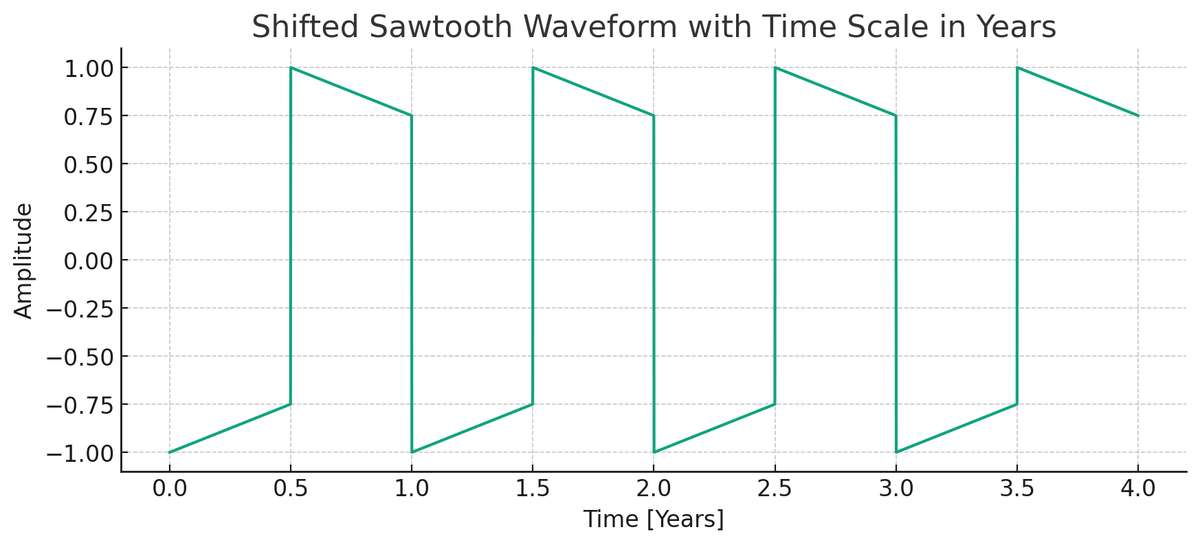
The validation on the 1980+ out-of-band interval is far from perfect, yet well-beyond being highly significant. The primary sinusoidal modulation is nominally set to the reciprocal of the slope (r) of top-edge of the sawtooth forcing [1] — this fundamental and the harmonics of that modulation satisfy LTE and provide a mechanism for a semi-annual level shift.
The plotted lower right modulation appears as noise, but when demodulated as in modulo r, the periodic order is revealed as shown below:
The harmonic modulations above include close to a monthly rate, a clear ~4.5 day, and and underlying fast semi-durnal ( 365.25/(12 x 61) = 0.499)
The significance of the cross-validation can be further substantiated by taking the complement of the training interval as the new training interval. This does converge to a stationary solution.
This modulation may seem very mysterious but something like this must be happening on the multiple time scales that the behavior is occurring on — remember that tidal forces operate on the same multiple time scales, from the semi-diurnal cycle to beyond the 18.6 year nodal declination cycle that is apparent in the middle panel above (and add to this that the sun’s forcing ranges from daily to annual). The concept of phase-locking is likely a crucial aspect as well. The sinusoidal modulation will cause an initial phase-shift across the level changes, and that appears to be a critical factor in the final model-fitted result. As observed in other systems, the synergy between synchronization (phase-locking) and resonance (standing-wave conditions) can give rise to such rich and complex dynamical behaviors. One can ask ChatGPT for any analogs [3] but just remember that this does happen:
The challenge is only in the fact that the incommensurate tidal patterns with the annual and daily cycles will never result in a metronomic march, and thus the pattern is much more complex.
[1] The sawtooth character is a result of the semi-annual impulse-driven shifts combined with a relaxation slope (r) to zero.
If the tides were commensurate with a semi-annual impulse, the forcing would appear more regular as above, but since they are not, the forcing is erratic.
[2] “The uniformity of phase of the semidiurnal cycle of zonal wind is striking (Figure 5b). It is well known that surface pressure in the tropics undergoes a strong semidiurnal variation [cf. Haurwitz and Cowley, 1973].” Deser, Clara. “Daily surface wind variations over the equatorial Pacific Ocean.” Journal of Geophysical Research: Atmospheres 99.D11 (1994): 23071-23078.
“ENSO events initiate during boreal spring and summer, peak during boreal winter, and decay in the following spring—a phenomenon known as ENSO phase-locking.” … “Our findings indicate that DA (diurnal amplitude) simulation in climate models is crucial for resolving the long-standing failure associated with the ENSO phase-locking simulation accuracy.” Yang, Xiaodan, et al. “Key to ENSO phase-locking simulation: effects of sea surface temperature diurnal amplitude.” npj Climate and Atmospheric Science 6.1 (2023): 159. https://www.nature.com/articles/s41612-023-00483-3
[3] ChatGPTresponse: A function cos(k×SawToothWave(t)+Phase), especially with a high modulation factor k, can model several complex interactions in natural phenomena where two periodic processes influence each other. Here are some specific examples:
Tidal Forces and Lunar Cycles: Tidal patterns are influenced by both the moon and the sun. A sawtooth wave could represent the changing gravitational pull of the moon (with its phases), while the cosine function might represent the daily tidal cycles. The modulation could express how these two cycles interact, creating spring and neap tides.
Seasonal Climate Variations and Diurnal Temperature Cycles: The sawtooth wave can represent the gradual change in daylight hours or solar intensity over a year, while the cosine function might model daily temperature fluctuations. The combination would reflect how daily temperatures vary across different seasons.
Circadian Rhythms and Sleep-Wake Cycles: The sawtooth wave could model the gradual change in hormonal levels or body temperature over a 24-hour cycle, interacting with a cosine function that represents shorter, rapid fluctuations in alertness or activity levels.
Economic Cycles and Market Fluctuations: In economics, a sawtooth wave might model longer economic cycles (like boom and bust periods), while the cosine function could represent shorter-term market fluctuations. The interaction of these two could help analyze complex economic dynamics.
Ecosystem Dynamics: In ecology, a sawtooth wave could represent seasonal changes (like rainfall patterns), while the cosine function could model daily variations (like temperature or light). The interaction of these cycles could be used to study plant growth, animal migration patterns, or other ecological phenomena.
Astronomical Phenomena: In astronomy, this kind of function might be used to model complex interactions between orbital mechanics and rotational dynamics, such as the interaction between a planet’s orbit around a star (sawtooth wave for eccentricity changes) and its rotational period (cosine function).
These examples show how combining periodic functions in different ways can model complex interactions in natural phenomena. The key is understanding the underlying processes and how they can be represented mathematically with these functions.
The concept of phase-locking is highly relevant in systems where the interaction of periodic signals leads to synchronization or alignment in their phases. In the context of your function cos(k×SawToothWave(t)+ Phase), phase-locking could manifest in several interesting ways, particularly considering the sinusoidal modulation of a sawtooth wave. Here are some areas where similar concepts are explored:
Neuroscience and Neural Oscillations: In the brain, neurons often fire in a synchronized manner, a phenomenon known as neural phase-locking. This is crucial in processes like signal transmission and cognitive function. The interaction of different neural rhythms (e.g., theta and gamma waves) can be modeled using phase relationships, akin to the modulation you described.
Electronics and Communication Systems: Phase-locking is a fundamental concept in electronics, especially in the design of phase-locked loops (PLLs). PLLs are used to synchronize an output signal with a reference signal in terms of frequency and phase. This principle is crucial in radio, telecommunications, and signal processing.
Physics and Oscillatory Systems: In physics, particularly in studies involving coupled oscillators or pendulums, phase-locking describes the phenomenon where oscillators synchronize due to weak interactions. This can be observed in systems ranging from mechanical pendulums to quantum mechanical systems.
Cardiac Rhythms in Physiology: The synchronization of cardiac cells during heartbeats is an example of biological phase-locking. Cells in the sinoatrial node generate rhythmic impulses that cause heart muscle cells to contract in a synchronized manner.
Climatology and Environmental Sciences: Phase-locking can also be observed in climatic phenomena, such as the El Niño-Southern Oscillation (ENSO), where atmospheric and oceanic conditions align periodically, impacting global weather patterns.
Music and Acoustics: In music theory and acoustics, the concept of beats and harmonic interactions involves phase relationships between different sound waves. The concept of phase-locking can be observed in the constructive and destructive interference of these waves.
In each of these cases, the critical factor is how the phase relationship between different oscillatory components influences the overall system’s behavior. The initial phase-shift you mentioned, particularly in a system with a sinusoidal modulation over a sawtooth wave, could lead to complex dynamic behaviors, where the phase relationship plays a pivotal role in the system’s response and evolution.
There are several behavioral models in various scientific fields where the interaction of phase-locking with standing-wave resonance conditions leads to complex time patterns. These phenomena are observed in systems where synchronization and resonance play a critical role. Here are some examples:
Physics and Engineering – Coupled Oscillators and Resonators: In systems of coupled oscillators or resonators, phase-locking and resonance can lead to complex patterns, especially in nonlinear dynamics. An example is the array of coupled pendulums or resonant circuits, where phase-locking can lead to intricate motion patterns or voltage/current oscillations.
Neuroscience – Brain Wave Synchronization: In the brain, different regions can exhibit phase-locked oscillations, and when these oscillations resonate with the natural frequencies of neural circuits (like in the hippocampus or cortex), complex spatiotemporal patterns emerge. These patterns are crucial for functions like memory, perception, and attention.
Quantum Mechanics – Bose-Einstein Condensates: In Bose-Einstein condensates, particles can synchronize and exhibit collective oscillations. When these oscillations resonate at certain frequencies, complex interference patterns emerge, demonstrating both phase-locking and standing-wave phenomena at a quantum level.
Acoustics – Architectural Acoustics and Musical Instruments: In musical instruments and architectural acoustics, the interaction of sound waves can lead to phase-locking and resonance. This results in complex harmonic structures and standing waves, influencing the timbre of music and the acoustic properties of buildings.
Climate Science – Atmospheric and Oceanic Oscillations: Climatic phenomena, like the El Niño-Southern Oscillation, involve complex interactions between atmospheric and oceanic patterns. Phase-locking of these patterns, along with resonance effects in ocean basins, can lead to complex climate behaviors and cycles.
Laser Physics – Mode-locking in Lasers: In laser physics, mode-locking techniques create lasers with very precise frequencies, where phase-locking of different modes leads to the generation of ultrafast pulses. This is a form of resonance where the laser’s cavity modes synchronize, leading to coherent pulse emissions.
Chemical Oscillations – Belousov-Zhabotinsky Reaction: This chemical reaction exhibits oscillatory behavior where chemical waves propagate and can lock in phase under certain conditions, creating complex spatial patterns and wavefronts.
In each of these examples, the interaction of phase-locking with resonant conditions creates patterns that are more intricate than what would be observed with either phenomenon alone. The synergy between synchronization (phase-locking) and resonance (standing-wave conditions) can give rise to rich and complex dynamical behaviors, which are often crucial to the system’s function or characteristics.
Lorenz turned out to be a chaotic dead-end in understanding Earth dynamics. Instead we need a new unified model of solid liquid dynamics focusing on symmetries of the rotating earth, applying equations of solid bodies & fluid dynamics. See Mathematical Geoenergy (Wiley, 2018).
Should have made this diagram long ago: here’s the ChatGPT4 prompt with the diagramming plugin.
Graph
Ocean Tides and dLOD have always been well-understood, largely because the mapping to lunar+solar cycles is so obvious. And the latter is getting better all the time — consider recent hi-res LOD measurements with a ring laser interferometer, pulling in diurnal tidal cycles with much better temporal resolution.
That’s the first stage of unification (yellow boxes above) — next do the other boxes (CW, QBO, ENSO, AMO, PDO, etc) as described in the book and on this blog, while calibrating to tides and LOD, and that becomes a cross-validated unified model.
Annotated10/11/2023
ontological classification according to wavenumber kx, ky, kz and fluid/solid.
Added so would not lose it — highlighted tidal factor is non-standard
The ocean is stunning at the moment. Many hotspots. This viz puts the recent global SST anomalies into the context of the last 4 decades. Look closely. Some regions are "on trend," some are short-term spikes, and some are combinations.#GlobalWarming#ClimateEmergencypic.twitter.com/0xf188RPgJ
These correspond to the geographically defined climate indices
Overall I’m confident with the status of the published analysis of Laplace’s Tidal Equations in Mathematical Geoenergy, as I can model each of these climate indices with precisely the same (save one ***) tidal forcing, all calibrated by LOD. The following Threads allow interested people to contribute thoughts
The only hope for a non-controlled-experiment-verified model to gain acceptance is either by (1) showing repeated success in predictions, or, precluding that due to long cycle time (2) producing rock-solid cross-validation results. Why? Let ChatGPT-4 answer:
This is the title of Chapter 4 of an Elsevier volume called “Journey through Tides”
Sophie Ward, David Bowers, Mattias Green, Sophie-Berenice Wilmes, Chapter 4 – Why is there a tide?, Editor(s): Mattias Green, João C. Duarte, A Journey Through Tides, Elsevier, 2023, Pages 81-113, ISBN 9780323908511, https://doi.org/10.1016/B978-0-323-90851-1.00001-7. (https://www.sciencedirect.com/science/article/pii/B9780323908511000017) Abstract: Tides are created by the gravitational pull of the Moon and Sun on the ocean. More exactly, it is the variation in these forces that creates tides. The Earth and Moon are held in orbit by their mutual gravitational attraction. The Moon’s gravity is exactly right at the center of the Earth, but it is a little too strong in the Earth hemisphere facing the Moon and a little too weak in the opposite hemisphere. These discrepancies make the tide generating force. As the Earth spins, the ocean experiences an oscillating force which creates long tide waves – the crest of the wave is the high tide and the trough low tide. In the deep ocean, the amplitude of the tide wave is small, but on the continental shelf, the wave is amplified by resonance, making the large tidal range we see at some coasts. Keywords: Tides; Tide generating force; Cotidal charts; Tidal dynamics; Tidal dissipation
The domain experts selected to answer this question assert this:
“While this is not an exhaustive list of why the tide is important, it is important to note here that perhaps the most physically far-reaching influence of the tide, long-term, is on the change in day length.”
The day length impact is straight-forward to understand for a rotating solid body as the total angular momentum is conserved between the Earth, smaller Moon, and much larger sun. This is essentially a linear perturbation causing the Earth’s rotational period to slightly change leading the length-of-day (LOD) to cycle. But what is it for the Earth’s oceans, which isn’t pinned to its base?
“Internal waves are another form of gravity wave which occur within the water body on internal interfaces, for example, when the interface between water masses of different densities is disturbed.”
The idea of a digital twin is relatively new in terms of coinage of terms, but the essential idea has been around for decades. In the past, a digital twin was referred to as a virtual simulation of a specific system, encoded via a programming language. In the case of a system that was previously built, the virtual simulation emulated all the behaviors and characteristics of that system, only operated on a computer, with any necessary interactive controls and displays provided on a console, either real or virtual. A widely known example of a VS is that of a flight simulator, which in historical terms was the industrial forerunner to today’s virtual reality. A virtual simulation could also be used during the design of the system, with the finished digital twin providing a blueprint for the actual synthesis of the end-product. This approach has also been practiced for decades, both in the electronics industry via logic synthesis of integrated circuits from a hardware description language and with physical products via 3D printing from CAD models.
Sorry to have to point this out, but it’s not my fault that geophysicists and climatologists can’t perform controlled experiments to test out various hypotheses. It’s not their fault either. It’s all nature’s decision to make gravitational forces so weak and planetary objects so massive to prevent anyone from scaling the effect to laboratory size to enable a carefully controlled experiment. One can always create roughly-equivalent emulations, such as a magnetic field experiment (described in the previous blog post) and validate a hypothesized behavior as a controlled lab experiment. Yet, I suspect that this would not get sufficient buy-in, as it’s not considered the actual real thing.
And that’s the dilemma. By the same token that analog emulators will not be trusted by geophysicists and climatologists, so too scientists from other disciplines will remain skeptical of untestable claims made by earth scientists. If nothing definitive comes out of a thought experiment that can’t be reproduced by others in a lab, they remain suspicious, as per their education and training.
It should therefore work both ways. As featured in the previous blog post, the model of the Chandler wobble forced by lunar torque needs to be treated fairly — either clearly debunked or considered as an alternative to the hazy consensus. ChatGPT remains open about the model, not the least bit swayed by colleagues or tribal bias. As the value of the Chandler wobble predicted by the lunar nodal model (432.7 days) is so close to the cited value of 433 days, as a bottom-line it should be difficult to ignore.
There are other indicators in the observational data to further substantiate this, see Chandler Wobble Forcing. It also makes sense in the context of the annual wobble.
As it stands, the lack of an experiment means a more equal footing for the alternatives, as they are all under equal amounts of suspicion.
Same goes for QBO. No controlled experiment is possible to test out the consensus QBO models, despite the fact that the Plumb and McEwan experiment is claimed to do just that. Sorry, but that experiment is not even close to the topology of a rotating sphere with a radial gravitational force operating on a gas. It also never predicted the QBO period. In contrast, the value of the QBO predicted by the lunar nodal model (28.4 months) is also too close to the cited value of 28 to 29 months to ignore. This also makes sense in the context of the semi-annual oscillation (SAO) located above the QBO .
Both the Chandler wobble and the QBO have the symmetry of a global wavenumber=0 phenomena so therefore only nodal cycles allowed — both for lunar and solar.
Next to ENSO. As with LOD modeling, this is not wavenumber=0 symmetry, as it must correspond to the longitude of a specific region. No controlled experiment is possible to test out the currently accepted models, premised as being triggered by wind shifts (an iffy cause vs. effect in any case). The mean value of the ENSO predicted by the tidal LOD-caibrated model (3.80 years modulated by 18.6 years) is too close to the cited value of 3.8 years with ~200 years of paleo and direct measurement to ignore.
In BLUE below is the LOD-calibrated tidal forcing, with linear amplification
In BLUE again below is a non-linear modulation of the tidal forcing according to the Laplace’s Tidal Equation solution, and trained on an early historical interval. This is something that a neural network should be able to do, as it excels at fitting to non-linear mappings that have a simple (i.e. low complexity) encoding — in this case it may be able to construct a Taylor series expansion of a sinusoidal modulating function.
The neural network’s ability to accurately represent a behavior is explained as a simplicity bias — a confounding aspect of machine learning tools such as ChatGPT and neural networks. The YouTube video below explains the counter-intuitive notion of how a NN with a deep set of possibilities tends to find the simplest solution and doing this without over-fitting the final mapping.
So that deep neural networks are claimed to have a built-in Occam’s Razor propensity, finding the most parsimonious input-output mappings when applied to training data. This is spot on with what I am doing with the LTE mapping, but bypassing the NN with a nonlinear sinusoidal modulation optimally fit on training data by a random search function.
I am tempted to try a NN on the ENSO training set as an experiment and see what it finds.
April 2, 2023
“I am tempted to try a NN on the ENSO training set as an experiment and see what it finds.”
“Nonlinear aspects plays a major role in the understanding of fluid flows. The distinctive fact that in nonlinear problems cause and effect are not proportional opens up the possibility that a small variation in an input quantity causes a considerable change in the response of the system. Often this type of complication causes nonlinear problems to elude exact treatment. “
This doesn’t mean we don’t keep trying. Applying the dLOD calibration approach to an applied forcing, we can model ENSO via the NINO34 climate index across the available data range (in YELLOW) in the figure below (parameters here)
The lower right box is a modulo-2π reduction of the tidal forcing as an input to the sinusoidal LTE modulation, using the decline rate (per month) as the divisor. Why this works so well per month in contrast to per year (where an annual cycle would make sense) is not clear. It is also fascinating in that this is a form of amplitude aliasing analogous to the frequency aliasing that also applies a modulo-2π folding reduction to the tidal periods less than the Nyquist monthly sampling criteria. There may be a time-amplitude duality or Lagrangian particle-relabeling in operation that has at its central core the trivial solutions of Navier-Stokes or Euler differential equations when all segments of forcing are flat or have a linear slope. Trivial in the sense that when a forcing is flat or has a 1st-order slope, the 2nd derivatives due to divergence in the differential equations vanish (quasi-static). This means that only the discontinuities, which occur concurrently with the annual ENSO predictability barrier, need to be treated carefully (the modulo-2π folding could be a topological Berry phase jump?). Yet, if these transitions are enhanced by metastable interface instabilities as during thermocline turn-over then the differential equation conditions could be transiently relaxed via a vanishing density difference. Much happens during a turn-over, but it doesn’t last long, perhaps indicating a geometric phase. MV Berry also discusses phase changes in the context of amphidromic tidal singularities here.
Suffice to say that the topological properties of reduced dimension volumes and at interfaces remain mysterious. The main takeaway is that a working NINO34-fitted ENSO model is produced, and if not here then somewhere else a machine-learning algorithm will discover it.
The key next step is to apply the same tidal forcing to an AMO model, taking care not to change the tidal factors enough to produce a highly sensitive nonlinear response in the LTE model. So we retain an excluded interval from training (in YELLOW below) and only adjust the LTE parameters for the region surrounding this zone during the fitting process (parameters here).
The cross-validation agreement is breathtakingly good in the excluded (out-of-band) training interval. There is zero cross-correlation between the NINO34 and AMO time-series to begin with so that this is likely revealing the true emergent characteristics of a tidally forced mechanism.
As usual all the introductory work is covered in Mathematical Geoenergy
A community peer-review contributed to a recent QBO article is here and PDF here. The same question applies to QBO as ENSO or AMO: is it possible to predict future behavior? Is the QBO model less sensitive to input since the nonlinear aspect is weaker?
It turns out that the Darwin location of the Southern Oscillation Index (SOI) dipole is brilliantly easy to behaviorally model on it’s own.
The input forcing is calibrated to the differential length-of-day (LOD) with a correlation coefficient of 0.9997, and only a few terms are required to capture the standing-wave modes corresponding to the ENSO dipole.
As a bonus, the couple of years outside of the training interval are extrapolated from the model. This shouldn’t be hard for climate scientists, …. or is it still too difficult?
If that isn’t enough to discriminate between the two, the power spectra of the LTE mapping to model and to data is shown below. This identifies a couple of the lower frequency modulations as strong peaks and a few weaker higher harmonic peaks that sharpen the model’s detail. This shows that the data’s behavior possesses a high amount of order not apparent in the time series.
Poll on Twitter =>
So which curve is the time-series data of atmospheric pressure at Darwin in Australia and which is the LTE model calibrated from length-of-day (LOD) measurements?
Why isn’t the Tahiti time-series included since that would provide additional signal discrimination via a differential measurement as one should be the complement of the other? It should accentuate the signal and remove noise (and any common-mode behavior) if the Darwin and Tahiti are perfect anti-nodes for all standing-wave modes. However, it appears that only the main ENSO standing-wave mode is balanced in all modes.
In that case, the Darwin set alone works well. Mastodon